|
|
Saltford Environment Group
|
|
SEG Home > The History of Saltford The History of SaltfordSaltford has a fascinating past. Whilst many are aware of Saltford's Domesday Book entry, our timeline reveals a remarkable history unsurpassed by any other English village. Saltford Environment Group's extensive research has revealed many facts about the amazing past of this Somerset village that remained largely unknown until now. Locals and visitors from all generations are finding the project of great interest.
Project NewsSince 2015 SEG's news page has featured stories concerning the History Project as its research and other activities have revealed previously little known information about Saltford's history. These news items range from when we first publish details of interesting "new" discoveries such as Saltford's oldest (1728) painting or artefacts such as the Saltford Carthaginian Coin and the Saltford Viking Buckle, archaeological surveys and digs, to the unveiling in 2016 at Saltford House of a Blue Plaque commemorating Admiral Kelly and the publication online of self-guided history walks of Saltford. These past news stories can be found on SEG's News page for recent news stories or in SEG's News Archive. History Project BackgroundAs part of its purpose to champion all that's great about Saltford for a better and more sustainable future, Saltford Environment Group (SEG) decided in early 2015 to research and record the history of Saltford on our website. Only by valuing our history and origins can we gain a better understanding of the importance that we as a community should take care of the land and people that support us all. In 2023 SEG and Saltford Community Association (SCA) agreed to work together in partnership to secure for the community the long term future of SEG's History of Saltford project. St. Mary's Church is also a partner in this community project. The first priority was to securely back-up SEG's extensive digital heritage records. These records include many hundreds of images that are now held safely in a digital archive for current and future generations of Saltford residents. The objective for SEG, SCA and St. Mary's in taking the project forward on behalf of the community is for Saltford's artefacts and some of the many images to be more accessible at special village events and at a more central and visited location than the Heritage Centre room. That has been located on the 1st floor of St Mary's Church hall where the location and lack of disabled access has always been a concern. In the future, a selection of artefacts and printed or digital panels may be displayed at Saltford Hall - either at special heritage/village events and/or in a display cabinet or via AV equipment. This is a significant evidence based community project. We are recording Saltford's history from pre-Roman times to the 20th Century and making it available for all to see here on our website. We have uncovered many fascinating facts about life in Saltford in past centuries. This is an iterative process, slowly growing and developing in content as we research and discover information. We are grateful for all offers of materials to help produce this unique record of Saltford but please be aware that if you are kind enough to offer material for us to use, we need to be selective in what we decide to publish and cannot guarantee to use everything supplied to us. If residents are able to lend us old photographs, sketches, historic documents etc. concerning Saltford (the older the better) please contact us (see below). Please note. This is a continuous and growing project that commenced in March 2015. New content is added on a regular basis. Project TeamA small Project Team from SEG's membership was initially established in early 2015 to plan the project and get it started. This is an ongoing process; we shall be constantly adding new information and images. The original Project Team (2015) comprised Phil Harding (SEG Chairman & Project Leader); Debbie Cini (SEG Secretary); Andrew Stainer (SEG Treasurer); Dick Bateman; and Jon Godfrey. Roger Vaughan was subsequently brought in to organise the geophysics surveys with BACAS. Phil Harding and Andrew Stainer continue to lead the project and they are also curators for the project's artefacts and records. Several SEG members assist the project on an ad-hoc basis.
Please see below for how to contact the History of Saltford project. Acknowledgements SEG would like to thank the following who have provided various contributions, research, guidance and other support to this project since 2015:- John Baker, Jamie Balsdon, Julian Balsdon, Dick Bateman, Adrian Betts, Dave Boston, Dave Brennan, Barbara Butler, Richard Canter, Derek Cann, Marie Carder, Debbie Cini, Jill Coles, Tony Coverdale, David Cox, Dave Curnock, Noel Dawson, Robin Dixon, Sue Dixon, Berenice "Bunty" & John Dunford, Trevor Ewins, William Feay, Steve Fillingham, Ivor Ford, Brenda Fry, Jon Godfrey; Malcolm Guthrie, Hilary Hallett, Phil Harding, Katie Horgan, Jaye, Steve Johnson, Robert Knaap, Leah, Richard Loxton, Owen McDermott, Dr Sam Moorhead (British Museum), Bob Mordle, Sam Norris, John Oswin, Jacob Rees-Mogg MP, Wendy Russ, St. Mary's PCC, Saltford Community Association, Carl Say, Martin Sessions (Canberra, NSW), Alan Sims, Hilary Smedley, Sally Smee, Adam Stratton, Alistair Sutherland, Margaret Stabbins, Richard Stabbins, Dave Taylor, Rob Taylor, Rosemary Turner, Roger Vaughan, Brian Vowles, Chris Warren, Robert Woodberry, Michael Worthington-Williams. We also thank everyone in the village who has supported and encouraged us on this project. Contacting the projectYou can contact the History of Saltford project via SEG's Chairman, Phil Harding - please state "SEG History Project" in the email subject heading. Photographs: A high resolution copy of some of the historic and contemporary photographs may be available on request to Phil Harding via the home page of this (SEG's) website. Where available these can be supplied in return for an agreed donation to SEG to help cover the cost of this online publication. Research: web links & guidanceHow to start researching your family history You can download here the 2-page How to start researching your family history guide (pdf) produced by the Saltford Parish Clerk for the WWI Armistice Centenary village event held on 11 November 2018. We use online and other records for our research including (click on blue links):- Forces War Records & Military Genealogy Historic England (includes The Heritage List of listed buildings, scheduled monuments etc.) Keynsham & Saltford Local History Society (online records: Births, Baptisms, Marriages and Burials) Know Your Place West of England project Portable Antiquities Scheme (PAS) SW Heritage Trust: Somerset Archive Catalogue The Anglo-Saxon Chronicle, J. A. Giles & J. Ingram (Gutenberg free ebooks) |
KEY PAGES:-TIMELINE (300 BC to the modern age) ON THIS PAGE:-Project Team (& Acknowledgements) Research: web links & guidance FEATURE ITEM:-SALTFORD'S OWNERS & PLACE NAME ORIGINS
SEG wishes to thank the following organisations for the support and/or advice they have given to this project:
NOTE:
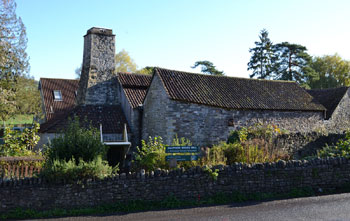
A mill is referred to in the Domesday Book entry for Saltford. Probably on the same site as the Domesday Book mill, Saltford Brass Mill was converted to working brass in the 18th Century. The Brass Mill is the only surviving building, still with a furnace and working water wheel, remaining from a group of 18th Century mills making copper and brass goods in the Avon Valley between Bristol and Bath. The mill worked brass until 1925. |









|
© Saltford Environment Group
|
|